Does Website Speed Affect Local SEO? What Core Web Vitals Actually Do
Website speed is a supporting signal, not a primary local ranking factor. Here's what Core Web Vitals measures, where it fits, and how to check your score.
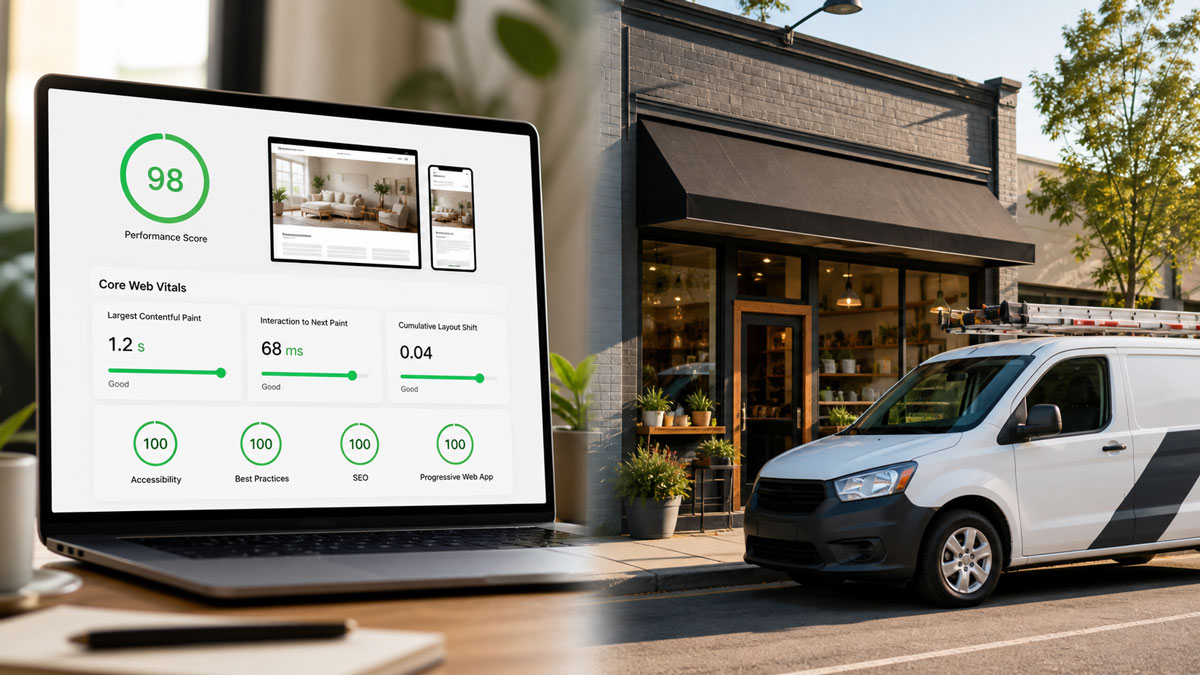
The short answer: Website speed is a secondary local SEO signal. Google’s local ranking algorithm is built on relevance, distance, and prominence—not speed. Core Web Vitals (Largest Contentful Paint, Interaction to Next Paint, Cumulative Layout Shift) function as a tie-breaker for organic rankings, especially when businesses compete with similar relevance. Improve speed because it reduces visitor drop-off and supports conversions, not because it’s the primary lever for 3-pack visibility.
Is website speed actually a local ranking factor?
Not the way most agencies pitch it. In our guide to how Google decides who gets into the Delaware local 3-pack, we cover the three core ranking factors: relevance, distance, and prominence. Site speed isn’t one of them. Google has confirmed that Core Web Vitals are a ranking signal, but the documented effect is strongest as a tie-breaker for organic search results, not as a primary driver of local 3-pack placement. When two competing pages have similar content relevance, the page with better Core Web Vitals scores gets an edge.
This is different from the claim that “speed determines your local ranking”—a distinction a lot of local SEO content glosses over. The distinction matters because the fixes differ: weak 3-pack visibility requires Google Business Profile optimization, citations, and reviews (covered in our pillar guide). A slow site needs a different approach.
What Core Web Vitals measures, in plain English
Core Web Vitals are three specific measurements of how a page performs in real-world use:
- Largest Contentful Paint (LCP) — how fast the main content loads (typically the hero image or headline). Slow LCP leaves visitors waiting on a blank screen.
- Interaction to Next Paint (INP) — how quickly the page responds when someone clicks a button, taps a menu, or fills a form. Poor INP creates the impression the site isn’t responding.
- Cumulative Layout Shift (CLS) — how much the page layout shifts while loading. High CLS is when you tap the phone number and an ad pushes it down before your tap registers.
Google reports each metric as “good,” “needs improvement,” or “poor.” They calculate scores using real visitor data when available, and lab data (Lighthouse) otherwise. Importantly, Google has never published specific ranking weights for each metric—no official statement that LCP is worth X% and INP is worth Y%. Any percentage breakdowns you see are estimates, not confirmed data.
Local 3-pack vs. organic: where speed actually plays a role
Most local SEO guides skip this distinction. Google actually runs two separate result types for local searches: the map pack (the three business pins) and the organic blue-link results below. They use different ranking factors.
The local 3-pack is driven almost entirely by Google Business Profile completeness and recency, proximity to the searcher, and review signals—the relevance, distance, and prominence factors. Site speed barely influences 3-pack placement.
Organic search results are where Core Web Vitals carry more weight. Google’s own guidance names them as a tie-breaker between pages with similar content relevance. Two Wilmington HVAC contractors with comparable service pages competing for organic placement might see the faster site rank higher. But a HVAC business trying to enter the 3-pack needs to focus on its GBP and citations first—speed alone won’t move the needle there.
There’s a second reason speed matters beyond rankings: visitor retention. A potential customer who reaches your site from either the 3-pack or organic results and abandons it because of slow loading never makes it to your phone number. Speed affects conversions even when it doesn’t affect rankings.
What “local website management” actually includes
If you arrived here searching for “local website management service,” the honest answer is that speed and Core Web Vitals are one component of an ongoing responsibility—not a one-time fix.
Proper local website management covers:
- Hosting and uptime monitoring — the site stays live and reachable.
- Security and dependency updates — CMS core, plugins, and third-party code patched before they become vulnerabilities.
- Core Web Vitals monitoring — checked on a schedule rather than discovered when customers complain.
- Content and service-page updates — pages that reflect current services, pricing, and service areas.
- Technical SEO health — correcting broken links, redirect chains, and schema markup as the site evolves.
A website built once and left alone will degrade across all five areas. Dependencies age, pages accumulate inefficiencies, and standards change. That gap between “a website” and “a managed website” is where Delaware Digital’s local website management service in Wilmington, DE covers hosting, security patching, and Core Web Vitals monitoring for Mid-Atlantic service businesses that lack in-house development resources. For businesses that need ongoing custom development alongside that maintenance, our WordPress development and support team handles that too. We handle the monitoring and maintenance that keeps performance and rankings stable.
How to check your own site’s score
You don’t need to trust anyone’s word on this—you can measure it yourself. Google’s free PageSpeed Insights tool takes under a minute:
- Go to pagespeed.web.dev.
- Enter your homepage URL.
- Run tests for both Mobile and Desktop—scores often differ significantly between the two, and mobile matters most for local searchers.
- Note your LCP, INP, and CLS results against Google’s thresholds, plus review the tool’s prioritized list of specific fixes.
If your mobile results come back “needs improvement” or “poor” across the board, that’s a real, documented signal worth addressing—not because it will single-handedly fix your local rankings, but because slow load times cause visitor drop-off before they ever reach your phone number or contact form. For the technical detail behind each metric, read Google’s official Core Web Vitals documentation.
When slow speed is a symptom of a bigger problem
If your PageSpeed test shows a slow site, that’s often a symptom of a larger architecture issue rather than the problem itself. Our guide on 9 signs your website needs a redesign covers a broader diagnostic—slow load times are one of nine common indicators, but rarely the only one. If slow speed stems from a complex stack of third-party SaaS tools and page-builder dependencies, the hidden cost of SaaS dependency explains why custom-built infrastructure often outperforms on both speed and total cost over multiple years.
Delaware Digital specializes in building and managing websites for Mid-Atlantic service businesses. We handle hosting, security, performance monitoring, and technical SEO in-house—no vendor chains, no black boxes. If you want a candid assessment of whether speed is your actual bottleneck, we’re happy to discuss your site’s current setup.