Delaware Local SEO: Dominate Google's Map Pack
For Delaware trades and professional services, Google's Local 3-Pack is where leads are won or lost. Here's how to own it and turn rankings into lead flow.
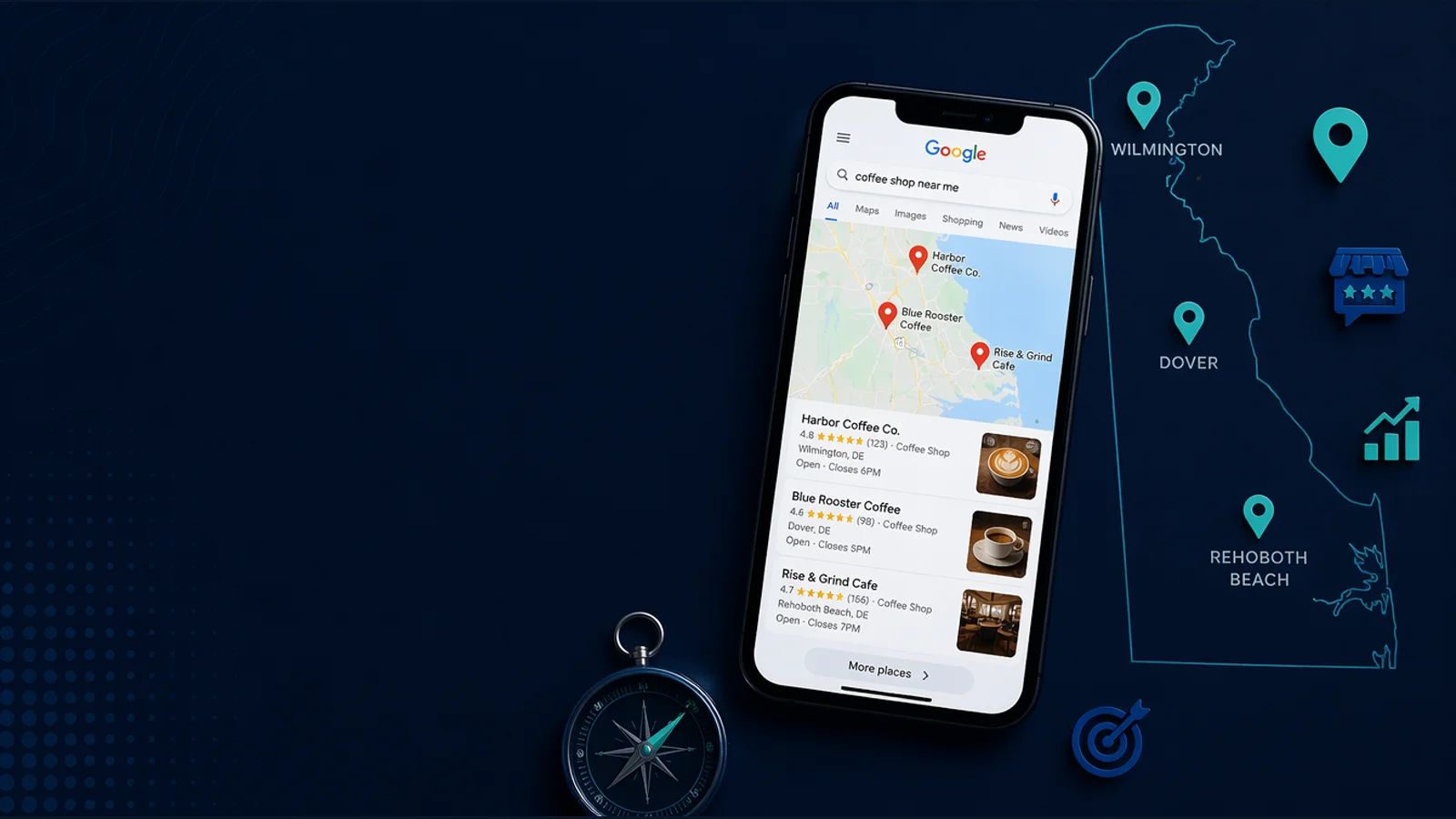
When a homeowner in Wilmington searches “emergency electrician near me” at 9 PM on a Tuesday, three businesses appear in Google’s local map pack. One of them gets the call. The other two don’t exist as far as that customer is concerned.
That’s the reality of local search in 2026. It’s not about being on page one — it’s about being in the box at the top of page one. Google’s Local 3-Pack captures the overwhelming majority of clicks on local service searches, and for established trades and professional services businesses in Delaware, it is the most valuable piece of digital real estate available.
This isn’t a guide about vanity metrics. It’s about lead flow — phone calls, form submissions, appointment bookings. If you run an electrical contracting company in Newark, a law firm in Wilmington, or an HVAC operation serving New Castle County, local SEO done right is a direct revenue driver. Local SEO done poorly is an expensive line item that never pays off.
Delaware Digital specializes in digital marketing services in Delaware. Our Delaware SEO company for qualified leads handles local SEO — including Google Business Profile optimization, citation management, city-specific landing pages, and review strategy — for established regional businesses. This post covers exactly how it works.
How Google Decides Who Gets in the Local 3-Pack
Google’s local ranking algorithm weighs three factors: relevance, distance, and prominence. Understanding how these interact is the foundation of every local SEO strategy we build.
Relevance is how well your Google Business Profile, website, and on-page signals match what the searcher is looking for. A plumbing company that has “Delaware plumber” buried in a footer paragraph ranks below one that has it in the business name, service categories, GBP description, and individual service pages.
Distance is proximity — how close your business location (or service area) is to the searcher’s location. For businesses with a fixed address, this is partially outside your control. For service-area businesses like contractors, you can define a service radius that expands your eligibility zone.
Prominence is the combination of off-site authority signals: the number and quality of local directory citations, inbound links from local organizations and business associations, Google reviews volume and recency, and overall domain authority.
Ranking in the Delaware Local 3-Pack requires a tripartite optimization strategy: maximizing geographical proximity signals via local schema markup, matching high-intent terms with localized landing page architecture, and establishing authority through NAP-consistent local directory citations. Real-time reviews on Google Business Profiles remain the primary click-through and ranking driver for regional services.
None of these three factors works in isolation. A business with a perfect GBP but no citations and no reviews won’t outrank a business with moderate optimization and 80 five-star reviews. The strategy has to address all three simultaneously.
What “Fully Optimized” Actually Means for a Google Business Profile
Most Delaware businesses have a Google Business Profile. Very few have one that’s actually working hard for them.
A fully optimized GBP isn’t just filling in the blanks. It’s a structured asset that signals authority to Google and converts browsers into callers. Here’s what that looks like in practice:
- Primary and secondary categories set correctly. Google uses these to match your listing to searches. “Electrician” is a category. “Emergency Electrician” is not — but it should appear in your service list, description, and posts.
- Services and products populated completely. Every service you offer should have its own entry with a description. This is content Google reads and indexes.
- Business description written for search intent, not brand narrative. Lead with the services you want to rank for and the geographic areas you serve.
- Photos updated regularly. Google’s algorithm factors photo recency. Businesses with recent, geotagged photos outperform those with static galleries that haven’t changed in two years.
- Questions & Answers section seeded and monitored. You can post your own Q&A pairs. Most businesses don’t. This is free content that appears on your listing and addresses objections before a prospect even calls.
- Google Posts published weekly. Posts expire after seven days. Consistent posting signals an active, credible business.
- Review response policy in place. Google rewards engagement. Responding to every review — positive and negative — within 48 hours is a ranking signal, not just good manners.
Getting this right is not a one-time setup. It’s an ongoing management process. We handle it as part of every local SEO engagement.
What Are Local Citations and Why Do They Matter for Delaware Businesses?
A local citation is any online mention of your business’s name, address, and phone number — the NAP trio. Yelp, Apple Maps, Bing Places, the Delaware State Chamber of Commerce directory, the Better Business Bureau, industry-specific directories like Angi for contractors or Avvo for attorneys — these are all citation sources.
Citations matter for one specific reason: they build trust signals that Google uses to confirm your business is real, established, and located where you say it is.
The problem most Delaware businesses have is not a lack of citations — it’s inconsistent citations. Your business name might appear as “Smith Electric LLC” on your website, “Smith Electrical” on Yelp, “Smith Electric” on Bing, and “S. Smith Electric & Sons” on an old Yellow Pages listing. Google sees these as potentially different businesses. That ambiguity suppresses your local rankings.
NAP consistency across every directory your business appears in is foundational local SEO hygiene. Beyond the major national directories, Delaware-specific citation sources include:
- Delaware.gov business listings
- Delaware Regional Chamber directories (New Castle County, Greater Wilmington)
- Visit Delaware and local municipality directories for service businesses
- Delaware State Bar Association (for law firms)
- Delaware Contractors Association (for trades)
Building new citations on high-authority directories and cleaning up inconsistent existing ones is one of the fastest ways to move local rankings — particularly for businesses that have operated for years but never managed their digital presence deliberately.
How Long Does Local SEO Take to Show Results in Delaware?
This is the question every business owner asks, and the honest answer is: it depends on your starting position, your competition, and how aggressively you execute.
Here are realistic, evidence-based timelines:
Google Maps / Local 3-Pack movement: 30 to 60 days. Map pack rankings respond relatively quickly to GBP optimization and citation improvements. If your current position is pages two or three of local results, you can often see meaningful movement within the first two billing cycles. If you’re showing at position 8–12 in the local pack (visible only when expanded), you can break into the top 3 within 60 days with consistent execution.
Organic / blue-link rankings: 90 to 180 days. Getting a city-specific service page from position 18 to position 3 for a query like “seo company delaware” or “wilmington electrician” takes longer because organic authority builds incrementally. Content needs to be indexed, linked to, and aged. Expect the first meaningful organic traffic lift around the 90-day mark, with continued compounding after that.
Lead volume impact: follows ranking movement. Phone call and form submission increases typically lag ranking improvements by two to four weeks, as it takes time for increased visibility to translate into traffic and traffic into conversions.
We set these expectations in writing at the start of every engagement. If a vendor promises page-one rankings in 30 days across all your target queries, ask them to define exactly what they mean — and get it in the contract.
Technical Health: The Foundation That Enables Local Rankings
Behind every ranking improvement sits a technically sound website. While local factors like GBP optimization and citations are the primary drivers, the technical foundation underneath matters more than most agencies acknowledge. Does your site’s speed actually affect your ranking? covers the nuanced relationship between Core Web Vitals and local SEO — speed isn’t the ranking factor most agencies claim it is, but a slow site can cost you conversions even if it ranks, and technical hygiene (crawlability, redirects, schema, indexation) is non-negotiable. That foundation work often happens invisible to the business owner, but it’s what separates competitive rankings from rankings that stick.
How to Target Multiple Delaware Cities Without Keyword Cannibalization
This is the structural challenge every multi-location contractor, law firm, and regional services business eventually faces. You serve Wilmington, Dover, Newark, and maybe Rehoboth Beach. You want to rank in all of them. How do you build that without your own pages competing against each other?
The answer is city-specific service pages, built correctly.
To rank across multiple cities in Delaware without search cannibalization, businesses must deploy unique, location-specific landing pages under a unified domain structure (e.g., city-specific pages) rather than splitting equity. Each page should feature unique, local case studies, local maps embeds, and tailored city-specific service descriptions while preserving standard canonical references.
What “unique” means in practice:
- Each city page has its own URL:
/services/electrician-wilmington/,/services/electrician-dover/,/services/electrician-newark/ - Each page leads with a city-specific headline and opening paragraph — not a template where only the city name is swapped
- Each page references real local context: nearby neighborhoods, local landmarks, local permit requirements, local projects you’ve completed
- Each page has its own H1, title tag, and meta description targeting the city-specific query
- Each page embeds a Google Map centered on that city’s service area
- Each page has its own internal link structure pointing to it from the main service page and, over time, from blog content
What “unified domain structure” means: all of these pages live on your primary domain, not on subdomains or separate sites. yourcompany.com/services/electrician-wilmington/ is correct. wilmington.yourcompany.com dilutes your domain authority across multiple properties.
The homepage handles statewide brand queries like “Delaware electrician” or “Delaware contractor.” The city pages handle geo-specific queries. There’s no overlap because the targeting is deliberate and distinct.
For law firms with multiple practice areas across multiple cities, this architecture scales to a matrix — one page per practice-area-city combination. It sounds like a lot of pages. It is. It’s also the only strategy that actually works at scale without self-cannibalization.
The Lead Capture Layer: What Happens After the Click
Ranking in the Local 3-Pack and on page one for Delaware service queries is only half the equation. The other half is converting that traffic into leads.
We connect local SEO infrastructure to lead capture and CRM systems so that every form submission and phone call is tracked, attributed, and routed correctly. This means:
- Call tracking numbers specific to each traffic source, so you know exactly how many calls came from local organic search vs. Google Ads vs. direct
- Form submissions routed to your CRM with source attribution preserved
- Conversion tracking in Google Search Console and Analytics 4 so ranking improvements can be tied directly to lead volume changes
This integration is what separates local SEO as a vanity exercise from local SEO as a revenue driver. When Pat can see that his Wilmington service page generated 14 phone calls last month — up from 3 the month before — the conversation about SEO budget becomes straightforward.
What Delaware Digital Delivers on Local SEO
Our local SEO engagements are not packages with predefined deliverable lists. They’re built around the specific competitive landscape in your service area and your current starting position. Typical engagements include:
- Full GBP audit and ongoing management
- NAP citation audit, cleanup, and new citation building
- City-specific landing page architecture and content
- On-page optimization for existing service pages
- Review acquisition strategy and response management
- Local schema markup implementation
- Monthly ranking and lead volume reporting with plain-English interpretation
We’re a Delaware company serving Delaware businesses. We don’t outsource work. We don’t use templated content. When your Wilmington landing page references local context, it’s because someone on our team who knows Delaware wrote it.
If you’re an established contractor, law firm, healthcare practice, or regional services business looking to turn local search into a measurable lead channel, the conversation starts with an honest assessment of where you stand today and what it will take to win your market.
Contact Delaware Digital to talk through your specific situation.
Looking for paid search to complement your local organic strategy? Read our guide on hiring a top PPC agency for Delaware local SEO context, or see how local SEO fits into a full digital marketing system in our 90-day domination framework. For a deeper look at how search strategy and site architecture work together, see what to look for in a Delaware SEO and web design agency.