Custom Website Cost in Delaware: 2026 Pricing Guide
Custom website pricing in Delaware ranges from $2,500 to $25,000+. Here's an honest breakdown of what drives cost and what Delaware businesses actually pay.
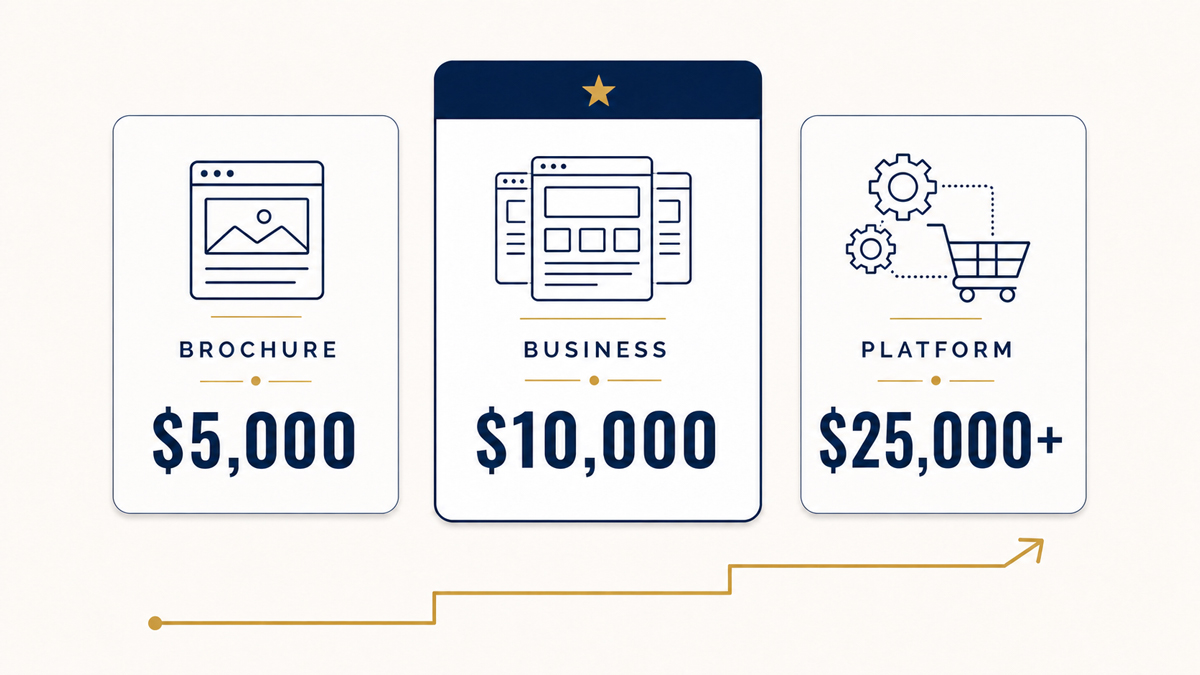
The short answer: a custom website in Delaware costs $2,500 to $30,000+, depending on what the business actually needs. That’s a wide range, and it needs context.
This guide breaks down what drives website cost, what each tier actually includes, what annual maintenance costs look like after launch, and what red flags to avoid when comparing proposals. All pricing reflects July 2026 rates from in-house Delaware teams; outsourced or offshore builds will vary.
Delaware Digital Q3 2026 estimating ranges by scope tier
The ranges below are Delaware Digital Q3 2026 estimating ranges — what we quote for in-house, custom-built projects. These are not market averages or Delaware-wide survey data; they reflect our specific team’s rates in Q3 2026. Prices do not include Delaware state or local sales tax. Rates from other agencies — offshore, template-based, or freelance — will differ. Use these to calibrate realistic expectations, not to benchmark every proposal in the market.
Scope assumptions behind these ranges:
- In-house Delaware team, no offshore or freelancer subcontracting
- Custom design from scratch, not a reskinned third-party theme
- Single language, single currency, US hosting
- Up to 2 revision rounds per major design phase; additional rounds quoted separately
- Client provides finalized brand assets (logo files, color palette, fonts); brand development quoted separately if needed
- Client provides finished copy on a defined schedule; copywriting quoted separately if needed (see line-item table below)
- Content migration not included unless explicitly scoped; add $500–$2,500 depending on volume and source platform
- Hosting, SSL, and domain are post-launch recurring costs, not included in build price
- Ecommerce: Stripe/PayPal integration and standard checkout flow included in the Platform tier range; complex inventory systems, custom fulfillment logic, or third-party ERP connections quoted separately
- Standard integrations (one CRM, one email platform) included in Lead-gen and Platform tiers; additional integrations quoted separately
| Scope tier | What’s included | Build cost range (Delaware Digital Q3 2026) | Annual maintenance (post-launch) |
|---|---|---|---|
| Brochure / marketing site | 5–10 pages, responsive design, contact form, basic SEO setup, Google Analytics | $2,500–$6,000 | $1,200–$2,400/year |
| Lead-generation site | Custom design, 10–20 pages, one CRM integration, conversion tracking, structured data | $6,000–$15,000 | $2,400–$4,800/year |
| Platform / e-commerce | Custom integrations, automation, standard checkout flow, 30+ pages or app-like features | $15,000–$30,000+ | $4,800–$9,600/year |
What annual maintenance covers: managed cloud hosting, SSL certificate renewal, security patches, dependency/framework updates, uptime monitoring, and a monthly support hour bank (1–4 hours depending on tier). Does not include major feature additions, design overhauls, or new integrations — those are scoped separately. A site without a maintenance agreement is a liability: hosting renewals, security patches, and framework updates don’t manage themselves.
If an agency gives you a number outside these ranges — significantly lower or higher — ask exactly what is included and who is doing the work.
What actually drives website cost
No two projects are the same, but most of the variance in a website proposal comes from the same five factors — each with a real dollar impact on the final quote.
1. Number of pages and content complexity
A 5-page brochure site and a 60-page service site both involve one designer and one developer — but the scope isn’t the same. More pages means more content decisions, more internal linking strategy, more QA, and more content to source or write. Every page adds time.
Typical impact: +$150–$300 per page beyond the base scope.
2. Custom integrations
Connecting your site to a CRM (HubSpot, Salesforce, Zoho), an email platform, an inventory system, or a payment gateway all require custom development. Each integration is its own project inside the project.
Typical impact: $1,500–$4,000 per integration, depending on API complexity and data mapping requirements.
3. Design complexity and brand maturity
If you have a full brand system — logo files, typography, color palette, photography — a designer can move quickly. If branding needs to be developed alongside the site, expect that to be quoted separately or bundled at a higher rate. Starting from a rough logo and “make it look professional” is genuinely more work.
Typical impact: $1,500–$5,000 added to the build if brand development is included; negligible if brand assets are ready on day one.
4. Content production
Most project delays trace back to content. If the agency is writing your copy, expect additional cost depending on page count and research depth. If you’re providing copy, plan for a content collection phase — and build in time for at least two rounds of review, because first drafts rarely match the final structure.
Typical impact: $1,000–$5,000 if copywriting is in scope; $0 if the client provides finished copy on a defined schedule.
5. SEO and technical infrastructure
A basic site can be indexed and functional without deep SEO work. A site built to generate leads needs proper heading structure, structured data (schema markup), Core Web Vitals above 90, and a content architecture designed around real search intent. This is the delta between a site that looks good and one that ranks and converts.
Typical impact: $1,500–$3,500 for a full technical SEO build-out, including local schema, page speed optimization, and structured data implementation.
Line-item cost drivers at a glance (Delaware Digital Q3 2026 estimating ranges)
All figures below are Delaware Digital Q3 2026 internal estimating ranges — in-house team, custom builds, no offshore subcontracting. Tax not included. These are not published market rates and should not be interpreted as typical prices for all Delaware web agencies.
| Component | Delaware Digital Q3 2026 range | Scope notes |
|---|---|---|
| Custom design (brochure scope) | $1,200–$2,500 | Brand assets provided by client; up to 2 revision rounds |
| Custom design (lead-gen scope) | $2,500–$5,000 | Includes UX/conversion wireframing; up to 2 revision rounds |
| Development — base build | $1,500–$4,000 | Framework setup, component library, responsive build |
| Development — per page beyond base | $150–$300 | Beyond the base page count in the selected tier |
| CRM integration | $1,500–$4,000 | Per integration; HubSpot, Zoho, Salesforce; varies by API complexity and data mapping |
| E-commerce / checkout | $3,000–$8,000 | Stripe/PayPal, cart, order management; complex fulfillment or ERP connections quoted separately |
| Copywriting | $75–$150/page | Depends on research depth and page complexity; does not include photography |
| Local SEO build-out | $1,500–$3,500 | Local business schema, page speed optimization, GBP integration, structured data |
| Content migration | $500–$2,500 | Migrating existing content from another platform; varies by volume and source format |
| Hosting setup (annual, managed) | $600–$1,800/year | Managed cloud hosting; varies by traffic volume and stack |
| Maintenance retainer | $150–$400/month | Updates, security patches, monitoring, monthly support hours; see maintenance details above |
If an agency gives you a number significantly below these ranges, ask what is not included and who is actually doing the work.
What $3,500 actually buys vs. what $12,000 actually buys
It helps to be concrete about what you get at different price points, because “custom website” means something different at every tier.
At $3,500–$5,000
You get a fast, responsive site with a clean design, 5–8 pages, a working contact form, and a Google Analytics connection. Mobile performance should be solid. You will not get custom CRM integration, conversion rate work, or a blog infrastructure. This is the right scope for a service business that needs a credible online presence and a phone number people can find.
At $8,000–$12,000
You get a site designed around conversion — clear service pages, a lead capture flow, structured data for local search, a CRM handoff, and a content structure that can expand. You’re not just building a site; you’re building an asset that feeds a sales pipeline. This is where Delaware service businesses — contractors, law firms, HVAC, healthcare — tend to see measurable ROI.
At $15,000–$25,000+
You get a platform. This is where e-commerce, custom account portals, automation workflows, and multi-location configurations live. The build itself is a software project with a product manager, a designer, a developer, and a QA pass before anything launches.
What to watch out for in proposals
A low quote is only a savings if the deliverable is what you actually needed.
Reskinned templates priced as custom: The fastest way to compress a quote is to drop your content into an existing theme. You will not get the same performance, flexibility, or SEO upside as a true custom build — and you will hit the ceiling faster.
Scope creep with no change-order process: If a proposal has no language about what happens when requirements change, every change request is a negotiation. Get a clear process for how changes are handled, priced, and approved before signing anything.
No post-launch plan: Websites break. Plugins update. Google changes its indexing signals. A site without a defined maintenance arrangement is a liability. Ask specifically who owns bugs, security patches, and hosting after launch.
Offshore teams billed as in-house: Delaware and national agencies sometimes route work through offshore development teams while presenting a local face. This isn’t inherently bad, but it changes communication timelines, revision cycles, and accountability. Know who is building your site.
Delaware-specific context
Delaware’s business landscape has its own quirks worth knowing.
The state has a high density of professional service firms — legal, financial, corporate services — that operate nationally but need locally credible websites. These firms tend to need less e-commerce complexity but more trust signals: clear credentials, specific practice area pages, and structured data that reinforces their authority in local search.
Delaware also has a strong contractor and trades market — HVAC, plumbing, electrical, roofing — where mobile-first performance and local SEO matter most. A site that loads in under two seconds on a phone and shows up when someone searches “HVAC repair Wilmington Delaware” is worth more than a visually impressive site that loads slowly and doesn’t rank.
If your business serves Delaware clients locally, prioritize Google Business Profile integration, local schema markup, and a fast mobile experience over design complexity. The most expensive website is the one that doesn’t convert.
What Delaware Digital charges and why
Delaware Digital builds custom websites in-house — no freelancers, no offshore handoffs, no platform reselling. Our rates align with the ranges above because that’s what in-house Delaware expertise costs in 2026.
We quote every project on scope, not on what we think a client will accept. Our proposals include a line-item breakdown, a timeline, and explicit language about what’s in scope and what triggers a change order. If that level of transparency isn’t standard in the proposals you’re comparing, ask why.
If you’re comparing quotes and one is significantly below market, the question to ask is: what is not included, and who is actually building this?
Frequently asked questions
How much does a custom website cost in Delaware in 2026?
In Delaware, a custom website typically costs between $2,500 and $30,000, depending on scope. A basic brochure site (5–10 pages, responsive design, contact form) runs $2,500–$6,000. A lead-generation site with custom design, CRM integration, and conversion optimization runs $6,000–$15,000. A full platform — e-commerce, automation, and custom integrations — typically starts at $15,000 and can exceed $30,000 for complex builds.
What's the difference between a template site and a custom website?
A template site uses a pre-built theme (Wix, Squarespace, or a WordPress theme) with your content dropped in. A custom website is designed and built specifically for your business goals, brand, and audience — with no shared codebase or platform limitations. Custom sites typically load faster, rank better over time, and can be extended with integrations a template can't support.
Does Delaware Digital charge for hosting or maintenance separately?
Yes. Custom website pricing covers design, development, and launch. Hosting, SSL, domain, and ongoing maintenance are scoped and quoted separately, typically $150–$400 per month depending on the stack and support level required. We put all costs in writing before any work begins.
How long does it take to build a custom website in Delaware?
A brochure or small marketing site takes 4–8 weeks from signed contract to launch. A lead-generation site typically runs 8–14 weeks. Complex platform builds depend on scope, but most projects in the $15,000+ range take 12–20 weeks. Delays almost always come from content — having your copy, photos, and brand assets ready shortens every timeline.
What should I look for when choosing a web design agency in Delaware?
Ask to see live sites they've built — not mockups. Ask who will own your work and where your data lives. Ask for references from clients whose businesses are similar to yours. And ask specifically what happens after launch: who handles bugs, updates, and your hosting? Agencies that hand off to third-party freelancers or lock you into proprietary platforms are the ones that create ongoing cost exposure.